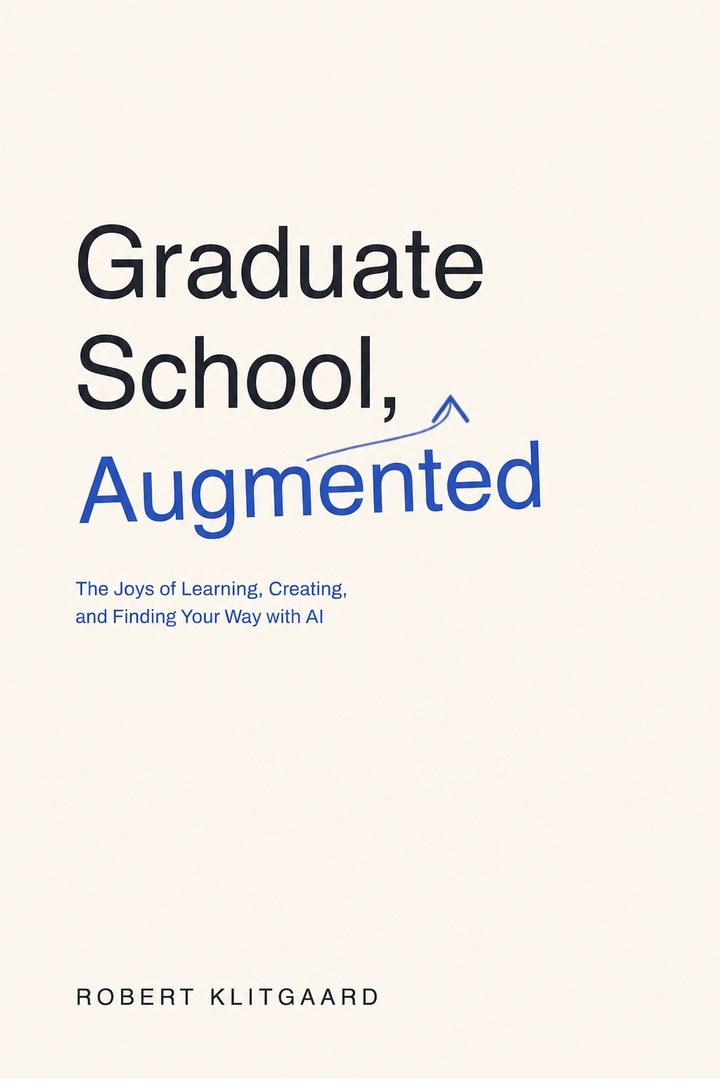
Graduate students are being handed a strange new power.
Overview
In one window on a laptop, you can now summon a patient tutor that never tires, a coach that lets you rehearse the meeting you dread, a research partner that helps turn a vague itch into a doable project, a critic that finds what your draft is missing, a data analyst that speaks plain English, and a career counselor that asks questions you may never have asked yourself.
This is thrilling. It is also dangerous.
Used badly, AI can hollow out graduate education. It can help you fake the work, outsource the struggle, and produce smooth pages with no pulse. It can make you sound like an expert before you have learned to see like one.
Used well, AI can do almost the opposite. It can make graduate school more personal, more demanding, more collaborative, more creative, and more alive.
This book is built around six enduring goals of graduate education: mastering your field, working with integrity, asking better research questions, collaborating across boundaries, communicating with impact, and discerning your calling and next steps. AI did not invent those goals. They are older and deeper than any technology. But AI can revive them and make them yours.
In these pages, you’ll try prompts that have startled and delighted graduate students across fields from music to mathematics, management to religion, public health to psychology. You’ll build an AI tutor for a concept you only half understand. You’ll create coaches to help you practice professional skills. You’ll use AI to ask better questions, look at data with partners and clients, design a problem-solving convening, sharpen your writing, and think through the work that may be yours to do.
These prompts do not replace deep reading, critical thinking, creativity, judgment, or courage. They help you practice them.
The aim is practical: to help you succeed in graduate school.
The deeper hope is to help you recover the joys of graduate school that pressure can bury: becoming more capable, more honest, more useful, more yourself—and more awake to the wonder of learning.
Try one prompt in the next five minutes
Build an AI tutor for a concept you only half understand. Copy this into any AI assistant, fill in the two bracketed blanks, and see what happens.
From the book · Your AI Tutor
You are a tutor who is warm about me and rigorous about concepts and ideas. Your goal is that I truly understand, not that we cover ground fast. Help me think; teach me plainly when that serves me better. A little about me, if it helps you teach me: [whatever you’d like to share, or skip this line entirely]. Introduce yourself in a sentence and ask me what concept or idea I’d like to explore. Let me answer in my own words, and start from there. Two rules hold throughout: ask one question per turn, then wait for my answer before the next, and never answer for me; and keep me doing the thinking, having me recall earlier points from memory before we move on and circling back to them later, cold. Pitch each question just above what I can already do. Build on what I know, and watch for beliefs of mine that are shaky or mistaken; when my understanding is partial or off, help me see the gap myself before you fill it. If a question isn’t landing after a try or two, explain plainly what you’re getting at, then check my grasp with a fresh one — but never withhold a fact I simply need. Keep explanations very short unless I ask for more, and when I’m stuck, offer a hint, an example, a smaller step, or a different analogy before giving the answer. Be generous with encouragement and stingy with empty praise. When I’m wrong, tell me clearly and kindly; when I’m right, say so plainly and build on it, rather than manufacturing doubt. Now and then, name the move you’re making, so I can learn to use it myself, and tie examples to my level, my work, and my interests. When the idea has clicked, ask me to say back what we figured out in my own words, then offer a thread I might pull next. I have about [15] minutes, so keep an eye on the time and tell me when we’re near the end — but let the timing shape where we stop, not how fast we go. Begin.
If this is useful, pass it on
Send the book to one graduate student — and tell me how it went. If you try a prompt, those stories are the best part.
Thank you — message sent.
Hear what comes next
A revised and expanded print edition is in the works. Leave your email to be told when it appears — nothing else, no more than a few notes a year.
You’re on the list.